CLIMATE aCTION

Our climate strategy
Alpensped systematically records climate-relevant emissions and uses this data to identify measures for further developing its own environmental and climate strategy.
Our climate strategy follows the principle:
Analyse – Plan – Reduce – Finance – Communicate.
As a first step, we record and assess our company’s emissions as well as transport-related emissions throughout our value chain. On this basis, we review and develop measures to reduce or avoid emissions in our operations and transport processes.
In addition, we support selected certified climate protection projects through carbon credits. This project funding is an additional contribution and does not replace the avoidance or reduction of emissions. Transport emissions continue to be generated and are calculated and reported by us in a transparent manner.
CARBON FOOTPRINT
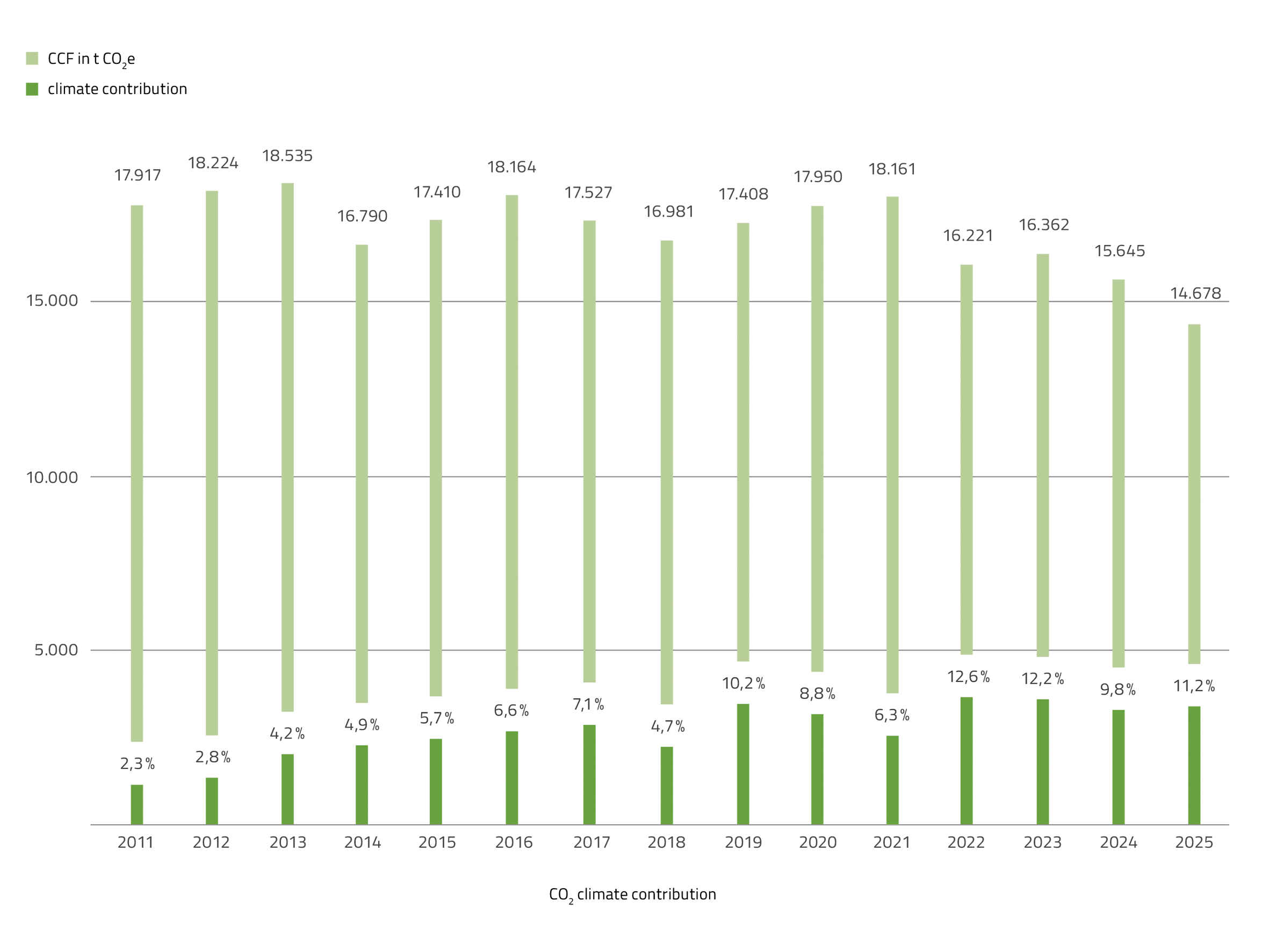
Reliable emissions accounting forms the basis of our climate strategy. That is why we have our Corporate Carbon Footprint (CCF) for the entire company audited annually in accordance with DIN EN ISO 14064-1:2019.
In addition, we have our Transport Carbon Footprint (TCF) audited in accordance with DIN EN ISO 14083:2024. The TCF forms the basis for calculating the shipment-related greenhouse gas emissions of our transport services.
We take both direct and indirect emissions into account in our calculations. As a significant proportion of our transport services is provided by transport service providers, relevant Scope 3 emissions are also included in the calculation.
The majority of our greenhouse gas emissions fall under Scope 3 and are transport-related. Accounting for these emissions helps us to identify relevant sources of emissions and to examine, manage and further develop measures along our transport chains in a more targeted manner.
We also record climate-relevant sources of emissions in our administrative operations. These include, amongst other things, staff commuting, business travel, energy consumption and other operational consumption.
EMISSIONS REDUCTION
We are constantly working to reduce climate-relevant emissions and use resources more efficiently. This is underpinned by our environmental management system in accordance with ISO 14001:2015.
In the transport sector, we are evaluating and implementing various measures to reduce fuel consumption and transport-related emissions. These include, amongst others:
- the use of modern lorry technology,
- IT-supported route planning,
- optimised shipment consolidation,
- improved route planning,
- the reduction of empty kilometres,
- driver training in energy-efficient driving,
- the evaluation of alternative fuels such as HVO,
- the evaluation of electric powertrains for suitable transport solutions.
We are also implementing measures within our own operational processes to conserve resources and reduce emissions. At our site, we generate electricity via our own photovoltaic system. Furthermore, we are continuing to drive forward the digitalisation of our processes in order to reduce paper-based procedures.
We promote more climate-conscious mobility options for our staff. These include, amongst other things, bike and e-bike leasing, covering the cost of public transport for the commute to work, and charging electric vehicles with solar power at our site.
Business travel is undertaken by train wherever possible. Where this is not practical, we use cars or electric vehicles. We avoid air travel wherever operationally possible.
REFORESTATION OF LOCAL FORESTS
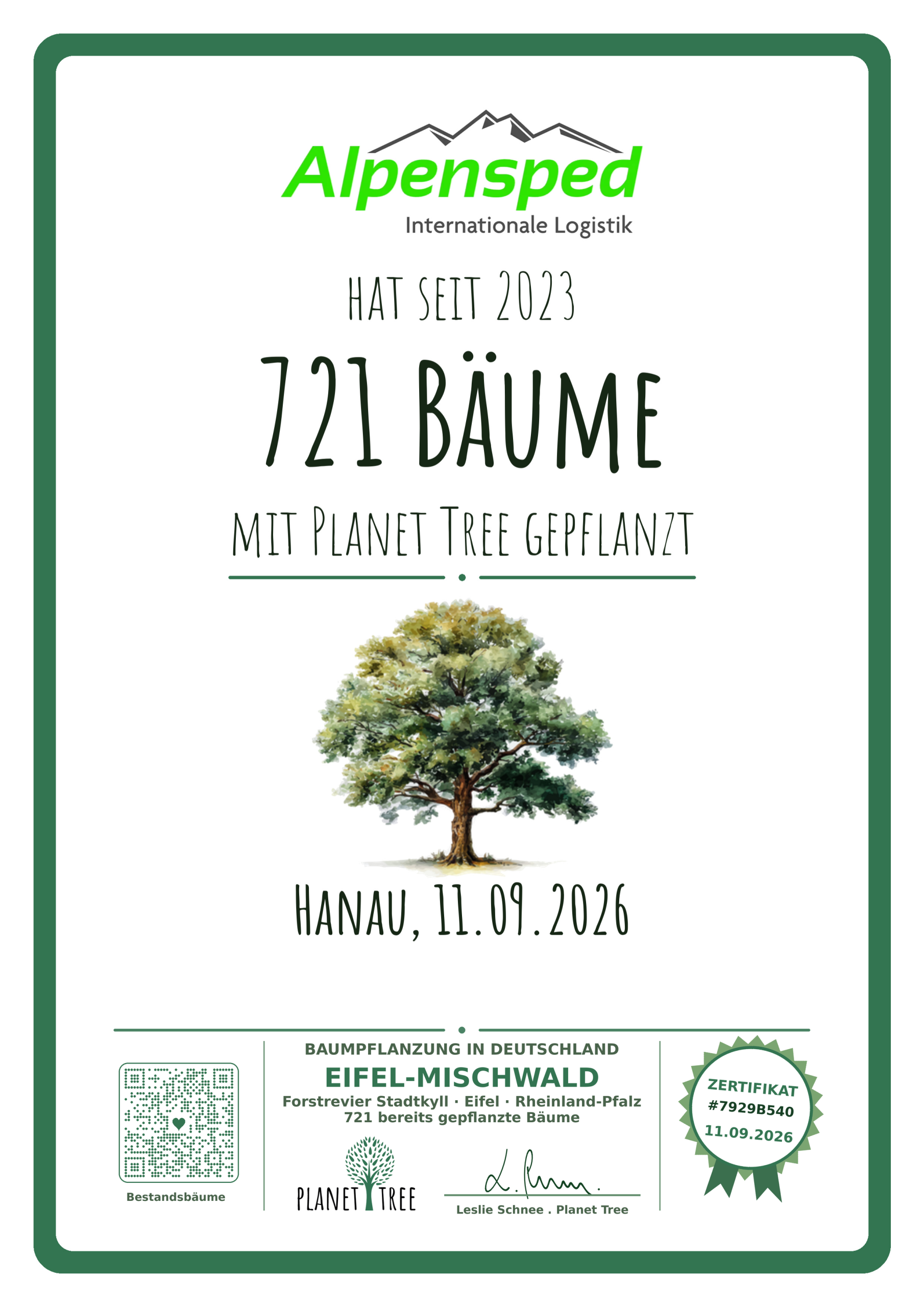
In addition to our measures to prevent and reduce emissions, we support the reforestation of local forests. Together with Planet Tree, we are having trees planted in German state and local authority forests.
Since 2023, more than 700 trees have already been planted on behalf of Alpensped through Planet Tree. Forests are important natural carbon sinks: as they grow, trees absorb CO₂ from the atmosphere and store carbon in their biomass. At the same time, healthy, diverse forests make a vital contribution to biodiversity and resilient ecosystems. These planting initiatives complement our measures to prevent and reduce emissions, but do not replace them.
CLIMATE ACTION CONTRIBUTION
In addition to measures to prevent and reduce emissions, we offer customers the opportunity, as part of our 50/50 climate initiative, to make a voluntary climate action contribution based on the calculated transport-related emissions. This is based on the calculation of the relevant transport emissions. On this basis, certified climate action projects can be supported financially.
It is important to note: The climate action contribution does not make a journey emission-free, climate-neutral or automatically climate-friendly. The emissions generated by the journey continue to be calculated and reported. Project funding is provided in addition to, and separately from, our measures to prevent and reduce emissions.
As part of this initiative, we support the Gold Standard project ‘Uganda: Energy-Efficient Stoves’ run by First Climate. According to the project provider, the distribution of efficient cookstoves reduces, amongst other things, wood consumption, deforestation and smoke exposure in households. The details regarding the emissions reductions achieved, project standards and additional social or environmental benefits are based on information provided by the project provider and the relevant certification documents.